
Showing posts with label language. Show all posts
Showing posts with label language. Show all posts
Tuesday, May 25, 2010
'Love' won't get you an Oscar
I love Wordle. Not only is it one of the best online toys I've come across, but it also allows you to present word counts as statistical graphs in a fun manner. Take, for instance, the BBC's Wordle experiment with Eurovision winning lyrics (see post below). Now, whereas the biggest winner - so far as words are concerned - in Eurovision is 'love', to win an Oscar for best picture, you need either 'American', 'Man' or 'Men', 'Best', 'One', or 'Godfather' in the title. In fact, if you want an Oscar for best picture, 'love' won't get you anywhere. See for yourself:


'Love': twelve points; 'amour': douze points
All you need is love, especially if you're a Eurovision contestant. The BBC had the brilliant idea to feed the lyrics of all winning songs of the Eurovision contest, from its inception in 1956 till now, into Wordle website - a magic online toy for creating word clouds (think of tag clouds) on the basis of how often a word occurs in a given text. Once common words like 'and', 'I' were removed, the most frequent word in Euroschmaltzy winning songs turned out to be 'Love'.

To be more precise, of the 12,299 different words that make up the BBC's own collection of 54 years' worth of Eurovision's winning lyrics, 'love' accounts for 2%. Not all that surprising, if you think that love is embedded in the Eurovision logo, is it.


To be more precise, of the 12,299 different words that make up the BBC's own collection of 54 years' worth of Eurovision's winning lyrics, 'love' accounts for 2%. Not all that surprising, if you think that love is embedded in the Eurovision logo, is it.

...And in case you're itching to find out what this year's lyrics word-cloud looks like, here it is:

On the basis of word frequency alone, the BBC predicts that this year's German entry, 'Satellite', has pretty decent odds for winning: it features the word 'love' no less than 26 times. Alles Liebe.
(Article and images from the BBC)
Saturday, May 22, 2010
A Babel of a map
Click on the map to enlarge.
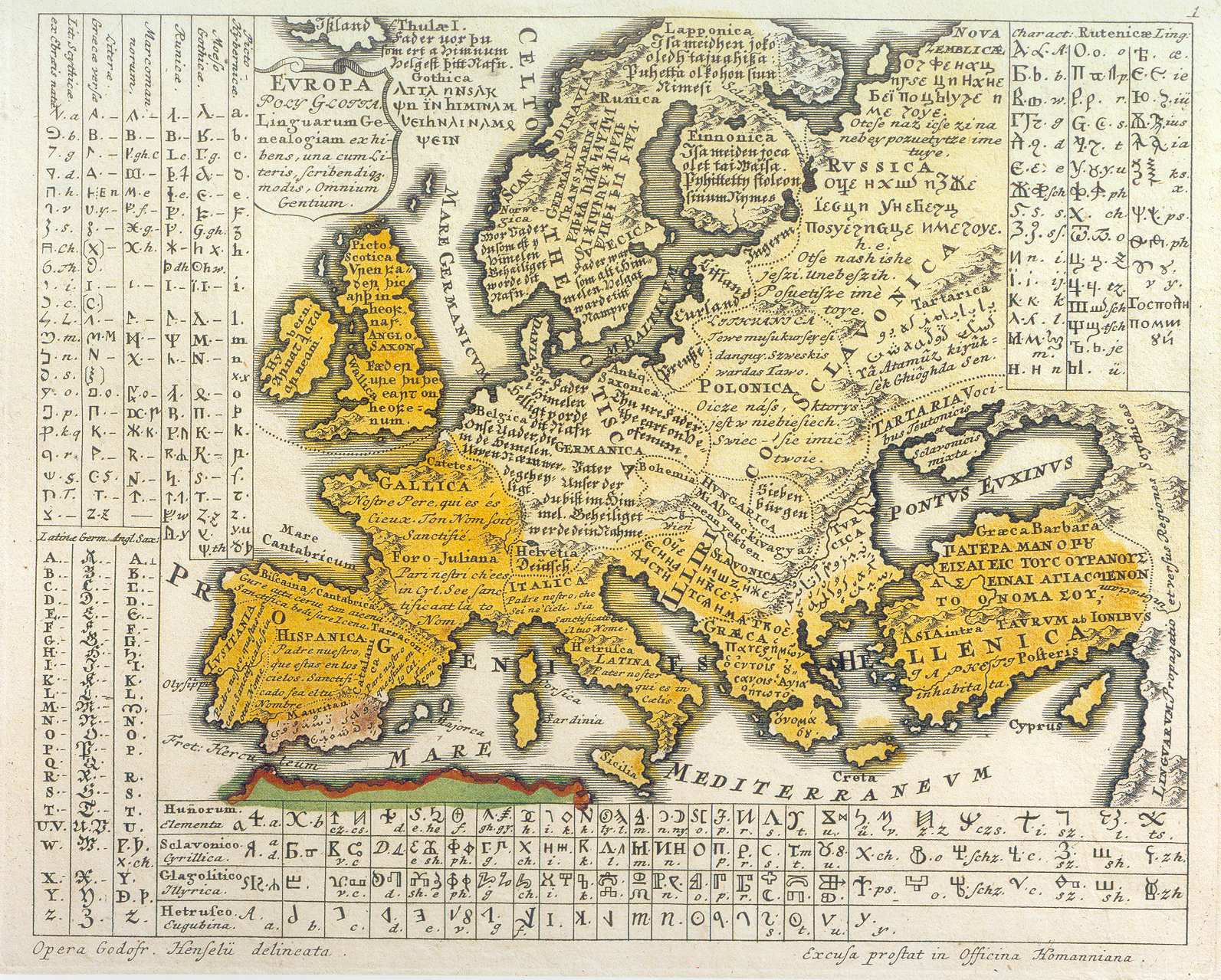
Image source

What a Babel of a map. Europa Polyglotta was published in 1730 by Gottfried Hensel. The full title is Europa Polyglotta, Linguarum Genealogiam exhibens, una cum Literis, Scribendique modis, Omnium Gentium. Now, Latin not being among my personal polyglot abilities, I looked it up. A fellow-blogger, Strange Maps, who's also posted a copy, suggests that the long title says something along the lines of 'Multilingual Europe, showing the genealogy of the languages, together with the alphabets and modes of writing of all peoples'. In this early example of comparative linguistics, Hensel has inscribed the first couple of lines of Our Lord's Prayer, or Pater Noster, in the language associated with each land. Somebody should send this with compliments to the EU staff who translate frantically every directive, paper, and regulation in every European language.
Thursday, May 13, 2010
Mind your P's and Q's
While minding one's B's and T's is certainly sound advice, as the post below proves, the original saying, of course, is 'mind your P's and Q's'.
There are various theories about the origin of the phrase, which dates at least from the late 18th century, most of which sound plausible. One theory is that the saying was a reminder to printers to make sure that they didn't confuse the letter p with the letter q while typesetting, although the evidence for this is, apparently, merely anecdotal. Today the phrase is often used as shorthand for 'mind your please and thank yous', but it's unclear whether the p's and q's expanded into or are a contraction of 'please and thank yous'.

My favourite one, however, attributes it to tavern keepers in England and New England, and probably other parts of the US: especially during busy times the tavern keeper would remind his staff to keep an eye on the running tally of pints and quarts that customers consumed, shortened to 'mind your P's and Q's'. This version is recorded in an 1852 issue of Harper's New Monthly Magazine, along with the following anecdote:
'The same writer, from whom we glean this information, mentions an amusing anecdote in connection with it, which had its origin in London, at the time a "Learned Pig" was attracting the attention of half the town. A theatrical wag, who attended the porcine performances, maliciously set before the four-legged actor some peas—a temptation which the animal could not resist, and which immediately occasioned him to lose the "cue" given him by the showman. The pig-exhibitor remonstrated with the author of the mischief, on the unfairness of what he had done ; to which he replied: "I only wanted to ascertain whether the pig knew his "peas" from his "cues !"’'

(Sources: Harper's New Monthly Magazine, 1852, p. 270; Historic Taverns of Boston: 370 Years of Tavern History in One Definitive Guide, by Gavin Nathan, 2006; Word myths: debunking linguistic urban legends, by David Wilton & Ivan Brunetti, 2004)
There are various theories about the origin of the phrase, which dates at least from the late 18th century, most of which sound plausible. One theory is that the saying was a reminder to printers to make sure that they didn't confuse the letter p with the letter q while typesetting, although the evidence for this is, apparently, merely anecdotal. Today the phrase is often used as shorthand for 'mind your please and thank yous', but it's unclear whether the p's and q's expanded into or are a contraction of 'please and thank yous'.

Image source

My favourite one, however, attributes it to tavern keepers in England and New England, and probably other parts of the US: especially during busy times the tavern keeper would remind his staff to keep an eye on the running tally of pints and quarts that customers consumed, shortened to 'mind your P's and Q's'. This version is recorded in an 1852 issue of Harper's New Monthly Magazine, along with the following anecdote:
'The same writer, from whom we glean this information, mentions an amusing anecdote in connection with it, which had its origin in London, at the time a "Learned Pig" was attracting the attention of half the town. A theatrical wag, who attended the porcine performances, maliciously set before the four-legged actor some peas—a temptation which the animal could not resist, and which immediately occasioned him to lose the "cue" given him by the showman. The pig-exhibitor remonstrated with the author of the mischief, on the unfairness of what he had done ; to which he replied: "I only wanted to ascertain whether the pig knew his "peas" from his "cues !"’'

(Sources: Harper's New Monthly Magazine, 1852, p. 270; Historic Taverns of Boston: 370 Years of Tavern History in One Definitive Guide, by Gavin Nathan, 2006; Word myths: debunking linguistic urban legends, by David Wilton & Ivan Brunetti, 2004)
Subscribe to:
Posts (Atom)