Les Classels, 'Le vent de la nuit', via PCL LinkDump
Showing posts with label film. Show all posts
Showing posts with label film. Show all posts
Sunday, June 13, 2010
'Le vent de la nuit'
Ridiculously, as long as I watched this, I could think of nothing else than the sperm scene in Woody Allen's Every Thing You Always Wanted to Know About Sex (But Were Afraid to Ask).

Friday, June 11, 2010
Soviet(?) stop-motion film features sailor dancing on piano keys
'Russian' and 'unidentified' seem to be the key words of the day. I wasn't able to find out more about the clip below, other than it features a 'Russian sailor' dancing on the keys of a piano, while the pianist is performing. The special effects, though impressive for the time, are not what's most striking about this clip. About half way through, the agile dancer morphs into a bizarre robotic creature, which continues dancing on the piano, with the pianist looking on.
Tuesday, June 8, 2010
Early American 'lost' films discovered in New Zealand
A collection of about 75 rare early American films discovered in the New Zealand Film Archive will be returned to the US National Film Preservation Foundation. The collection is said to include films that were considered forever lost, plus Upstream, a silent film made in 1927 by quintessentially 'American' director John Ford. Although Ford is best known for films such as Stagecoach, Fort Apache, Rio Grande, or The Quiet Man, around 1927-1928 he made more than 60 silent films, very few of which have been preserved complete (full article in the Guardian).


Image source

Sunday, June 6, 2010
More Kojak than usual
Here's a greater expanse of Kojak's bare skin than usual.

The tab of the iOffer webpage featureing this rather odd (and of dubious taste) appearance of Telly Savalas bears the equally odd title 'telly savalas for sale'.
Sunday, May 30, 2010
Easy Rider: God damn the Pusher
From Easy Rider, directed by Dennis Hopper (1969)
'You know I've smoked a lot of grass
O' Lord, I've popped a lot of pills
But I never touched nothin'
That my spirit could kill'
'The Pusher', Steppenwolf (1968)
O' Lord, I've popped a lot of pills
But I never touched nothin'
That my spirit could kill'
'The Pusher', Steppenwolf (1968)
The end of an uneasy ride: RIP Dennis Hopper
Legend has it that James Dean once gave fellow actor Dennis Hopper this advice: "drink the drink, don't act drinking the drink". Dennis Hopper, who died on 29 May, aged 74, applied Dean's principle zealously for much of his life.

Starting his acting career with a part in American TV drama 'Cavalcade of America' in 1952, Dennis Hopper gained TV fame with his role in another TV drama, 'Medic', in 1955. In the same year he was cast alongside James Dean in 'Rebel without a Cause', and the following year in 'Giant', James Dean's last film. Dennis Hopper has appeared in dozens of films and TV dramas, including his part as Billy Clanton in Gunfight at the O.K. Corral (1957), an episode of "The Twilight Zone" (1963), "Bonanza" (1964), his iconic part, again as Billy, in Easy Rider (1969), which Hopper co-wrote together with Peter Fonda, and directed himself, his incarnation of Tom Ripley in Wim Wenders's Der amerikanische Freund (1977), his role as a photojournalist in Apocalypse Now (1979), in which - as many critics noted - he appeared to play himself, the part of the father in Rumble Fish (1983), and his memorable role as Frank Booth in Blue Velvet (1986).

Dennis Hopper also appeared in TV commercials and continued to pursue his acting career, which, however, declined as his drug and drinking habits hijacked his life. His often erratic behaviour on and off film sets made it increasingly difficult for him to find work as an actor. Until rehab restored his acting career to some extent, Hopper channelled much of his creative energy into painting, photography, poetry, and occasionally directing, for which he has received some acclaim.


His personal life matched his career in ups and downs: Hopper is survived by five ex-wives, including former Mamas & Papas member Michelle Phillips, who filed for divorce barely a week after the wedding. In October 2009 Hopper was diagnosed with advanced prostate cancer, of which he died on 29 May 2010.

Image source
Starting his acting career with a part in American TV drama 'Cavalcade of America' in 1952, Dennis Hopper gained TV fame with his role in another TV drama, 'Medic', in 1955. In the same year he was cast alongside James Dean in 'Rebel without a Cause', and the following year in 'Giant', James Dean's last film. Dennis Hopper has appeared in dozens of films and TV dramas, including his part as Billy Clanton in Gunfight at the O.K. Corral (1957), an episode of "The Twilight Zone" (1963), "Bonanza" (1964), his iconic part, again as Billy, in Easy Rider (1969), which Hopper co-wrote together with Peter Fonda, and directed himself, his incarnation of Tom Ripley in Wim Wenders's Der amerikanische Freund (1977), his role as a photojournalist in Apocalypse Now (1979), in which - as many critics noted - he appeared to play himself, the part of the father in Rumble Fish (1983), and his memorable role as Frank Booth in Blue Velvet (1986).
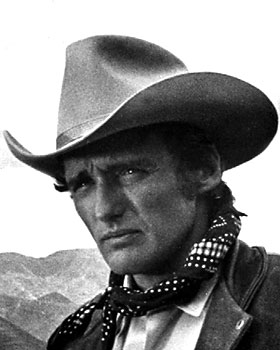
Image source
Dennis Hopper also appeared in TV commercials and continued to pursue his acting career, which, however, declined as his drug and drinking habits hijacked his life. His often erratic behaviour on and off film sets made it increasingly difficult for him to find work as an actor. Until rehab restored his acting career to some extent, Hopper channelled much of his creative energy into painting, photography, poetry, and occasionally directing, for which he has received some acclaim.

In 1975, Dennis Hopper was arrested and charged with reckless driving, leaving the scene of an accident, and evading arrest (sources: NNDB, the Guardian)

A photo by Dennis Hopper, from Dennis Hopper: Photographs 1961-1967, Taschen Books.
His personal life matched his career in ups and downs: Hopper is survived by five ex-wives, including former Mamas & Papas member Michelle Phillips, who filed for divorce barely a week after the wedding. In October 2009 Hopper was diagnosed with advanced prostate cancer, of which he died on 29 May 2010.
Friday, May 28, 2010
Vader Pasha: Turkish Star Wars
Apparently, the Turkish version of Star Wars was not, I repeat, not meant as a parody.
If you decide to watch one of the longer clips available on the internet, such as this one, which is about 9 minutes long, may the force be with you.
If you decide to watch one of the longer clips available on the internet, such as this one, which is about 9 minutes long, may the force be with you.
Tuesday, May 25, 2010
'Love' won't get you an Oscar
I love Wordle. Not only is it one of the best online toys I've come across, but it also allows you to present word counts as statistical graphs in a fun manner. Take, for instance, the BBC's Wordle experiment with Eurovision winning lyrics (see post below). Now, whereas the biggest winner - so far as words are concerned - in Eurovision is 'love', to win an Oscar for best picture, you need either 'American', 'Man' or 'Men', 'Best', 'One', or 'Godfather' in the title. In fact, if you want an Oscar for best picture, 'love' won't get you anywhere. See for yourself:


Friday, May 7, 2010
A step-by-step stop-motion recipe for a birthday cake
Food about you - Annecy festival 2010 from Alexandre DUBOSC on Vimeo.
To celebrate the 50th anniversary of the animation film festival of Annecy 2010.
http://alexandre-dubosc.com
Spotted on Titam's site
Tuesday, April 27, 2010
After Post-its, a stapler
Well, after all this Post-it stuff, an excerpt from the Post-it's natural habitat, the office - in this case, The Office seems most appropriate.
Sunday, April 25, 2010
Alan Sillitoe dies aged 82
Alan Sillitoe (1928-2010), iconic author of kitchen-sink dramas such as The Loneliness of the Long-Distance Runner and Saturday Night, Sunday Morning, has died in hospital aged 82. Sillitoe, a prototypical Angry Young Man (although averse to the label), left his mark in British culture with his take on everyday dramas, concerning everyday, unglamorous people - hence the 'kitchen sink' label.
Born to a Nottingham working-class family himself, he began writing around 20, while convalescing from tuberculosis. He has published novels, short stories, plays, poetry, and essays, as well as an autobiography (Life without Armour, 1995).

Tony Richardson's The Loneliness of the Long Distance Runner (1962) was based on a short story by Sillitoe, which bears all the marks of the kitchen-sink drama: class consciousness, class identity, class conflict, all embodied in the figure of an Angry Young Man.
Although the film's handling of class conflict lacks the subtlety of more nuanced examples of the genre, Tom Courtenay is absolutely superb as Colin Smith, the young, working-class Nottingham delinquent, pitted by circumstance and choice against the marginalising system. And Colin Smith's choice, to let deliberately someone else win the race, remains a bold rejection of an entire package of principles that, in promoting all-or-nothing antagonism, have proved antagonistic to social cohesion. Effectively, in that story, Alan Sillitoe argues that, in fact, it is the establishment that is guilty of 'anti-social behaviour'.
For more biographical details and a list of publications see the British Council's entry; obituary in the Guardian.
Born to a Nottingham working-class family himself, he began writing around 20, while convalescing from tuberculosis. He has published novels, short stories, plays, poetry, and essays, as well as an autobiography (Life without Armour, 1995).

Image source
Tony Richardson's The Loneliness of the Long Distance Runner (1962) was based on a short story by Sillitoe, which bears all the marks of the kitchen-sink drama: class consciousness, class identity, class conflict, all embodied in the figure of an Angry Young Man.
Although the film's handling of class conflict lacks the subtlety of more nuanced examples of the genre, Tom Courtenay is absolutely superb as Colin Smith, the young, working-class Nottingham delinquent, pitted by circumstance and choice against the marginalising system. And Colin Smith's choice, to let deliberately someone else win the race, remains a bold rejection of an entire package of principles that, in promoting all-or-nothing antagonism, have proved antagonistic to social cohesion. Effectively, in that story, Alan Sillitoe argues that, in fact, it is the establishment that is guilty of 'anti-social behaviour'.
Excerpt from The Loneliness of the Long Distance Runner (1962)
For more biographical details and a list of publications see the British Council's entry; obituary in the Guardian.
Saturday, April 24, 2010
This is Spinal Tape
Does for adhesive tape what This Is Spinal Tap did for rock-star mockumentaries.

Here's the official product description: 'A handy spinal cord on a roll. Use this tape to seal and stick with endless sacral style. Make your packaging go to 11! 25 meters of 2” wide packing tape.'
Available on Copernicus, spotted on Boing Boing.
This is Spinal Tap
Now, the spinal tap originally referred to the lumbar puncture - and still does in medical circles and contexts. But in 1984 all that changed: ever since director Rob Reiner's epic mockumentary This is Spinal Tap, Google's top results on 'spinal tap' refer to the film, not to the medical procedure (try it).
The wholly fake documentary about the rise and fall - and the bumpy ride in between - of the wholly fictitious heavy-metal band Spinal Tap is what you might call the perfect spoof: at the time, it convinced innocent (and perhaps a tad too trusting) filmgoers that they were watching a genuine documentary about a genuine rock band of pathetically pretentious, spoiled, capricious (and accident-prone) rock stars. You could say that it struck a chord among real-life rock stars though. Apparently, it made Tom Waits cry while watching it. Sting, on the other hand, didn't know whether to laugh or to cry, even though he's said to have watched it at least 50 times.
Rob Reiner, who had a real cinematic meta-moment directing himself as Marty DiBergi, the fictitious director of the Spinal Tap documentary, captured so accurately the glorification of the monumental silliness that inflates the images of rock stars to preposterous proportions that in the case of the recent Anvil! The Story of Anvil documentary it appeared that life imitated art (which imitated life to start with): viewers were convinced that the film, which recounts the sorry story of a failing Canadian heavy-metal band, was yet another cinematic prank on a Spinal-Tappesque scale. 'The music lasts forever. Maybe the debt does too' (see the closing credits) epitomises it all.
The name of Anvil! director Sacha Gervasi certainly compares well with Rob Reiner's alias 'Marty DiBergi'. But to top it all, uncannily enough, Anvil's drummer (one of the Spinal Tap's running jokes concerned the bizarre fates of that band's drummers) is named Robb Reiner. You really couldn't make it up.
The wholly fake documentary about the rise and fall - and the bumpy ride in between - of the wholly fictitious heavy-metal band Spinal Tap is what you might call the perfect spoof: at the time, it convinced innocent (and perhaps a tad too trusting) filmgoers that they were watching a genuine documentary about a genuine rock band of pathetically pretentious, spoiled, capricious (and accident-prone) rock stars. You could say that it struck a chord among real-life rock stars though. Apparently, it made Tom Waits cry while watching it. Sting, on the other hand, didn't know whether to laugh or to cry, even though he's said to have watched it at least 50 times.
Rob Reiner, who had a real cinematic meta-moment directing himself as Marty DiBergi, the fictitious director of the Spinal Tap documentary, captured so accurately the glorification of the monumental silliness that inflates the images of rock stars to preposterous proportions that in the case of the recent Anvil! The Story of Anvil documentary it appeared that life imitated art (which imitated life to start with): viewers were convinced that the film, which recounts the sorry story of a failing Canadian heavy-metal band, was yet another cinematic prank on a Spinal-Tappesque scale. 'The music lasts forever. Maybe the debt does too' (see the closing credits) epitomises it all.
The name of Anvil! director Sacha Gervasi certainly compares well with Rob Reiner's alias 'Marty DiBergi'. But to top it all, uncannily enough, Anvil's drummer (one of the Spinal Tap's running jokes concerned the bizarre fates of that band's drummers) is named Robb Reiner. You really couldn't make it up.
'Does for rock and roll what "The Sound of Music" did for hills'
The Anvil! The Story of Anvil trailer
Friday, April 23, 2010
Disco balls - such as the one illuminating legendary disco dancer Alfred E. Neuman on the cover of MAD above - are a totemic symbol of the disco era. Nevertheless, contrary to what you might expect, your great-grandmother may have danced the Charleston under one, at least if she happened to have lived in a city in Europe or the US in the early 20th century. Although it wouldn't have been known as a disco ball at the time, the mirror ball (or glitter ball, ball mirror, or specular sphere) graced dance floors as far back as the late 19th century.
You can spot them in the still below from the nightclub sequence of the wonderful 1927 silent film Berlin: Symphony of a Great City, or, in the original German, Berlin: Die Sinfonie der Großstadt, directed by Walter Ruttmann, and scripted by none less than Karl Freund and Carl Mayer.

You can spot them in the still below from the nightclub sequence of the wonderful 1927 silent film Berlin: Symphony of a Great City, or, in the original German, Berlin: Die Sinfonie der Großstadt, directed by Walter Ruttmann, and scripted by none less than Karl Freund and Carl Mayer.

Thursday, April 22, 2010
OK Corral court records discovered
The notorious 30-second OK Corral shootout in aptly named Tombstone, Arizona, which left the McLaury brothers and Billy Clanton - all 'Cowboys' - dead on 26 October 1881 caused quite a sensation in the press at the time. Court staff have now discovered records of the inquest following the gunfight while clearing out a storeroom (BBC).

The Cowboys' killers - Wyatt Earp, Morgan Earp, Virgil Earp, and Doc Holliday - were exonerated, but Virgil Earp, the town marshall, was discharged: the locals suspected that what was presented as crime fighting was, in fact, common murder, the bloody result of a feud between the Earps and the Clantons.
In the equally famous 1957 film version of OK Corral (Gunfight at the O.K. Corral), Wyatt Earp, who is described as a 'legendary frontiersman of the American West, [...] an itinerant saloonkeeper, gambler, lawman, gunslinger, and confidence man', is played by Burt Lancaster, while Kirk Douglas plays Earp's buddy, the consumptive drifter Doc Holliday, described as a 'gambler, gunman, and sometime dentist' (Britannica).

While, almost inevitably, the otherwise unremarkable town of Tombstone does its best to cash in on its now glorified Wild West notoriety by attracting tourists with tacky re-enactments of the gun battle (to which children are taken, if you listen carefully while watching the video below), the local governor's business sense is, to say the least, mercenary: as the BBC reports, 'Earlier this month Arizona Governor Jan Brewer, a Republican, signed into law a measure allowing Arizonans to carry concealed firearms without a permit.'

Newspaper cutting about the gunfight. Image source
The Cowboys' killers - Wyatt Earp, Morgan Earp, Virgil Earp, and Doc Holliday - were exonerated, but Virgil Earp, the town marshall, was discharged: the locals suspected that what was presented as crime fighting was, in fact, common murder, the bloody result of a feud between the Earps and the Clantons.
In the equally famous 1957 film version of OK Corral (Gunfight at the O.K. Corral), Wyatt Earp, who is described as a 'legendary frontiersman of the American West, [...] an itinerant saloonkeeper, gambler, lawman, gunslinger, and confidence man', is played by Burt Lancaster, while Kirk Douglas plays Earp's buddy, the consumptive drifter Doc Holliday, described as a 'gambler, gunman, and sometime dentist' (Britannica).

Image source
While, almost inevitably, the otherwise unremarkable town of Tombstone does its best to cash in on its now glorified Wild West notoriety by attracting tourists with tacky re-enactments of the gun battle (to which children are taken, if you listen carefully while watching the video below), the local governor's business sense is, to say the least, mercenary: as the BBC reports, 'Earlier this month Arizona Governor Jan Brewer, a Republican, signed into law a measure allowing Arizonans to carry concealed firearms without a permit.'
Wednesday, April 21, 2010
The unofficial father of Austrian cinema: Johann Schwarzer
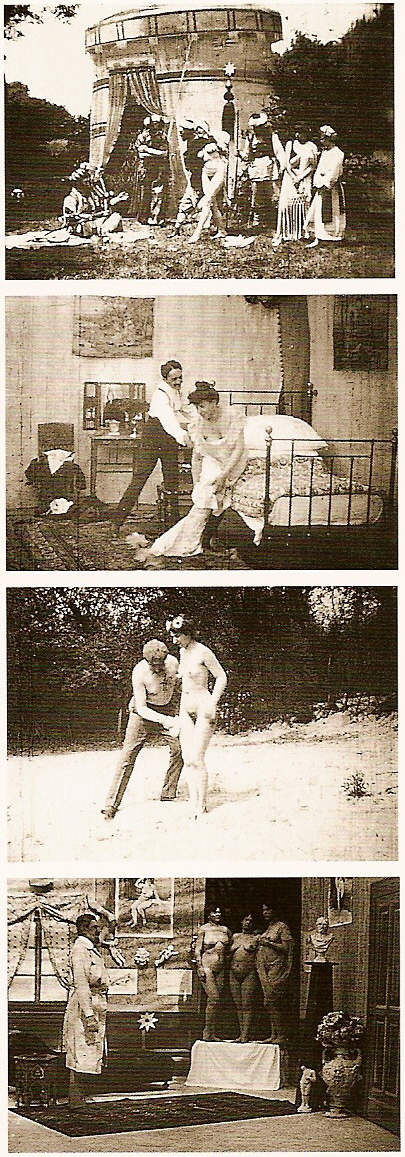
Schwarzer began his brief career as a photographer who quickly found out that female nudity sold well. In 1906 he founded his Saturn-film production company, and, going one better than his contemporary Pathé brothers, instead of titillating gentlemen viewers with French ladies in various stages of undress, he enticed them with plenty of Austrian full frontal nudity (image source: Wikimedia)
Although by today’s standards Saturn films look innocuous, in 1910 some of Schwarzer’s strait-laced compatriots, including Catholic associations, demanded and obtained the enforced dissolution of the company, while most of the films, including negatives, were destroyed. Thanks to a few devoted Saturn fans, notably film collector Albert Fidelius, copies of some of those films were salvaged and eventually restored by the Filmarchiv Austria. As for Schwarzer, he was never able to resume work: he was among those killed in the first year of World War I (Source: Europa Film Treasures; Wikipedia, in German).
Below, Das eitle Stubenmädchen (The Saucy Chambermaid), one of Scwharzer's lighthearted short films:
Das eitle Stubenmädchen (1908).
Friday, April 2, 2010
Play with matches
Sometimes it's OK to play with matches. A black-and-white animation film from 1912, from the Europa Film Treasures Archive. Directed by Emile Cohl.

Watch Les Alumettes fantaisistes here.
Thursday, April 1, 2010
Tuesday, March 30, 2010
Too early for what?

Myrna Loy and William Powell in The Thin Man (1934)
“Would you like a drink?”
“It’s a little early, isn’t it?”
“Too early for a drink?”
“No! Too early for stupid questions! Of course I want a drink!”
Via TYWKIWDBI
Wednesday, March 24, 2010
Mesmer at work
Georges Méliès turns into Mesmer in this stencil-coloured film from 1904.
The real Mesmer (1734-1815), a controversial physician with a mystical streak, bequeathed us the practice that later evolved into hypnosis, as well as the word 'mesmerise'.
In his time, he became famous - and infamous in some circles - for inventing (rather than discovering, as he maintained) 'animal magnetism', which has come to describe the power of physical attraction. However, Mesmer's idea of it had to do with an occult physical force emanating from an obscure, magnetic bodily fluid, rather than with raunchy instincts.
Although animal magnetism was dismissed as quackery, Mesmer's ideas fascinated, among others, Mary Shelley, whose fictional Dr Victor Frankenstein animated the cadaverous creation that Boris Karloff immortalised. In this short film, however, Mesmer, played by Méliès himself, animates a bunch of entirely benign, pretty young ladies.

The real Mesmer (1734-1815), a controversial physician with a mystical streak, bequeathed us the practice that later evolved into hypnosis, as well as the word 'mesmerise'.
In his time, he became famous - and infamous in some circles - for inventing (rather than discovering, as he maintained) 'animal magnetism', which has come to describe the power of physical attraction. However, Mesmer's idea of it had to do with an occult physical force emanating from an obscure, magnetic bodily fluid, rather than with raunchy instincts.
Although animal magnetism was dismissed as quackery, Mesmer's ideas fascinated, among others, Mary Shelley, whose fictional Dr Victor Frankenstein animated the cadaverous creation that Boris Karloff immortalised. In this short film, however, Mesmer, played by Méliès himself, animates a bunch of entirely benign, pretty young ladies.
Watch it here.
Subscribe to:
Posts (Atom)