Showing posts with label astronomy. Show all posts

Monday, July 5, 2010

The oldest light

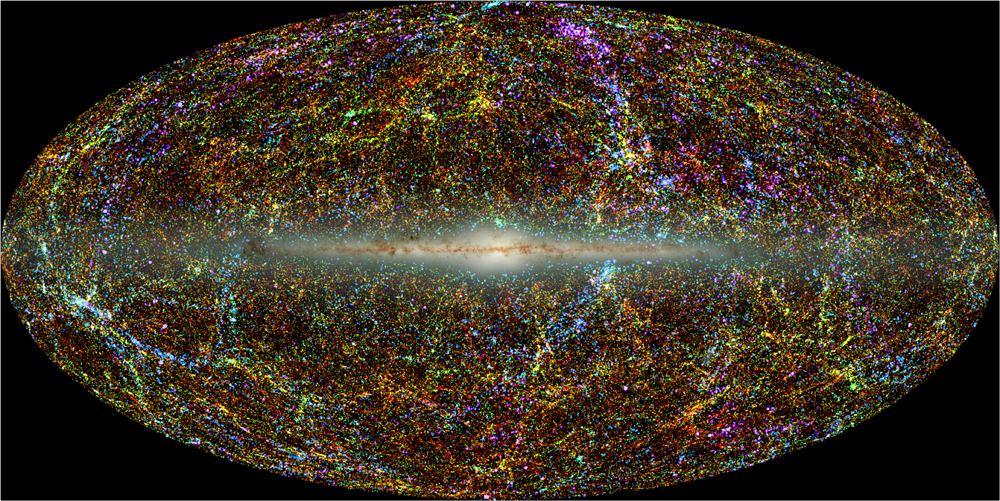
To me 'microwave' is associated with drab meals, scalding hot on the outside, still frozen inside, rather than with anything as stunning as the image below. This is the first full-sky portrait 'taken' by Europe's Planck telescope. The map, which took 6 months to complete, records the light emitted by cosmic gas and dust. It also records the 'cosmic microwave background', or CMB as it's known, the oldest light in the universe (more on the BBC).

Click to enlarge

Full-sky maps that record only visible starlight look very different, as do maps based on infrared or X-ray emissions. You can compare different views of the sky on Chromoscope. Here, for example, is another stunning portrait of the sky in near-infrared from WISE:

Click to enlarge

Monday, June 7, 2010

Tantalising Titan

The Cassini spacecraft has been keeping an eye on Titan for a while now. Titan has wind, rain, seasons, sand dunes, lakes, shorelines. But with surface temperatures of −179 °C, Saturn's largest satellite - the only natural satellite in the solar system with a proper atmosphere - is way too cold for water. Below its ice crust, however, it looks like there might be an ocean of liquid water thanks to the presence of ammonia. Where there's water, there may, just may be life. An even more exotic possibility is the idea of life forms adapted to liquid methane or ethane, of which Titan has plenty of lakes on its surface. 
An image Cassini took on 12 May 2007 reveals that Titan has seas, shorelines, islands, bays, channels and peninsulas, much like the Earth (image source: NASA).

'In 2005', reports the New Scientist, 'Chris McKay of NASA's Ames Research Center in Moffett Field and Heather R Smith of the International Space University in Strasbourg, France, calculated that such microbes could eke out an existence by breathing in hydrogen gas and eating the organic molecule acetylene, creating methane in the process.' That would translate into a lack of acetylene and hydrogen near the surface. Now, the Cassini probe has found exactly that kind of evidence.

Above, Titan's sand dunes; the bright spots are not clouds but surface features. Below, for comparison, terrestrial sand dunes in Namibia (both images: NASA).

Prudently enough, scientists are quick to emphasise that the same evidence could be be produced by chemical, rather than biochemical, reactions. But the mere possibility that Cassini's measurements might be a sign of life elsewhere in our solar system has fired up the imagination of scientists and space afficionados around the world. No-one has seriously suggested anything more complex than microbes, but of course proof of any form of life, no matter how simple somewhere other than our planet would be sufficient to convince anyone (except possibly Creationists and their ilk) that the Earth is not the universe's elect planet, uniquely blessed - or cursed - with life. Plus, the mere notion that Titan's low gravity and highly dense atmosphere would allow humans to fly if they simply attached artificial wings to their arms is dizzyingly exciting.

Three false-colour snapshots of Titan, taken by Cassini in October 2005, December 2005, and January 2006 reveal a highly dynamic atmosphere over the south pole (image source: NASA).

(Article sources: New Scientist, Wikipedia, NASA)

Monday, May 24, 2010

Star nibbles on planet

Scientists have created the image of a start gobbling up a planet in the Auriga constellation, about 600 light years away, using data transmitted by the Hubble telescope. Although the star is too distant for Hubble to photograph, the data are detailed enough to allow Dr Carole Haswell (Open University, UK) and her team to translate them into the image below.


With surface temperatures over 1500°C, the unlucky planet's literally melting in its orbit tracks, as it circles the star. Actually, despite the dramatic image, the star is nibbling on, rather than gobbling up, the planet. According to Dr Haswell, the star will probably take the final bite in about 10 million years (image and article from the BBC).

Monday, April 26, 2010

The Alien Within

Projection, as Carl Jung defined it, is loosely understood as the unconscious, i.e. unintentional transfer of subjective ideas and emotions onto someone else - 'an outer object': when we 'project', we attribute to others motives they may not have or emotions they may not be experiencing. Most likely, those projected motives and emotions reflect what we've learned to expect from others, and our own motives and emotions.

In that sense, Professor Hawking's warning against seeking contact with aliens seems like a perfect example of species-wide projection: "We only have to look at ourselves to see how intelligent life might develop into something we wouldn't want to meet" warned Professor Hawking alien enthusiasts (BBC). In his view, while it's perfectly rational to assume that intelligent life must have evolved, and exist as we speak, on other planets, alien visitors might well turn out to be ruthless space conquistadors.

 The German poster for War of the Worlds (1953), based on H.G. Wells's novel.

Stephen Hawking definitely has a point so far as 'we' and the way we've developed are concerned. And he may well turn out to have a point about those so far hypothetical aliens: as Jung stressed, 'projection' is not an arbitrary delusion. Very seldom is what we project all in our mind. Usually, there's at least a small element of what we attribute to another person actually there, except that we tend to blow it out of all proportion - and act accordingly.

Which makes Professor Hawking's argument against seeking contact with aliens all the more persuasive: even if alien visitors are not predatory conquerors, since that's what our species has learned to expect from its infancy, we're likely to treat them as such, and rush to apply the Bush Doctrine onto an intergalactic scale. That'd be fun.

 Image: Stray Snippets

Wednesday, April 21, 2010

Here comes the Sun

Today it's going to be a Sunny day. NASA has released the first public images and videos of the Sun, captured by its Solar Dynamics Observatory (SDO), which was launched in February and will be sending data to NASA hopefully for the next five years.

The high-resolution images and amazing close-ups of the Sun are awesome - in exactly the sense that this much-abused word best expresses. So, scroll down for more Sunny views.

Sunflower! 

Extremely bright, and with plenty of flare: meet the Sun

Dreamy colours spiralling into each other. It's false, colour; I know. But still. The close-up of the Sun's flare in the last 20 seconds of the video is simply mesmerising - it feels more like art than astronomy.


'AIA multi-temperature images of eruption and flare - AIA: This movie shows a flare and blast wave from an eruption. The dark region is where the erupting material has evacuated. The sequences are made from combinations of different AIA wavebands into a single image, with different colors representing different temperatures and layers of the atmosphere.'

A temperamental star

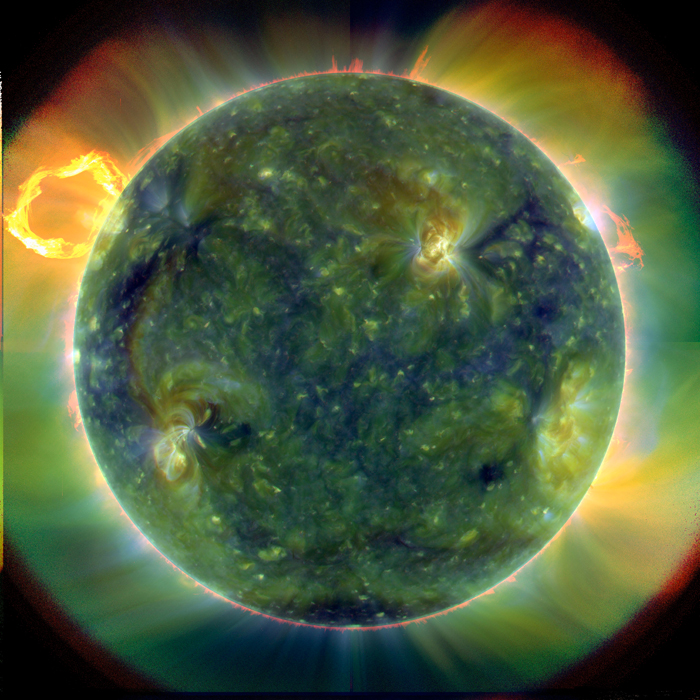
This stunning, multi-temperamental image combines different wavebands into a single, beautiful portrait of the Sun. The coolest colours represent, in fact, the hottest temperatures, whereas reds represent a relatively comfortable temperature of 60,000 Kelvin.

' A full-disk multiwavelength extreme ultraviolet image of the sun taken by SDO on March 30, 2010. False colors trace different gas temperatures. Reds are relatively cool (about 60,000 Kelvin, or 107,540 F); blues and greens are hotter (greater than 1 million Kelvin, or 1,799,540 F). Credit: NASA'
Source: NASA


Most prominent: the SDO has captured a prominence eruption. Source: NASA


Here's an older image of coronal loops. The tiny blue blob is a proportional representation of the Earth. 
From NASA:
'Coronal loops are fountains of plasma (a gas made up of electrically charged particles) trapped by the sun's magnetic fields. Coronal loops look like giant arches sticking out of the solar surface, and many are large enough to span several Earths.'